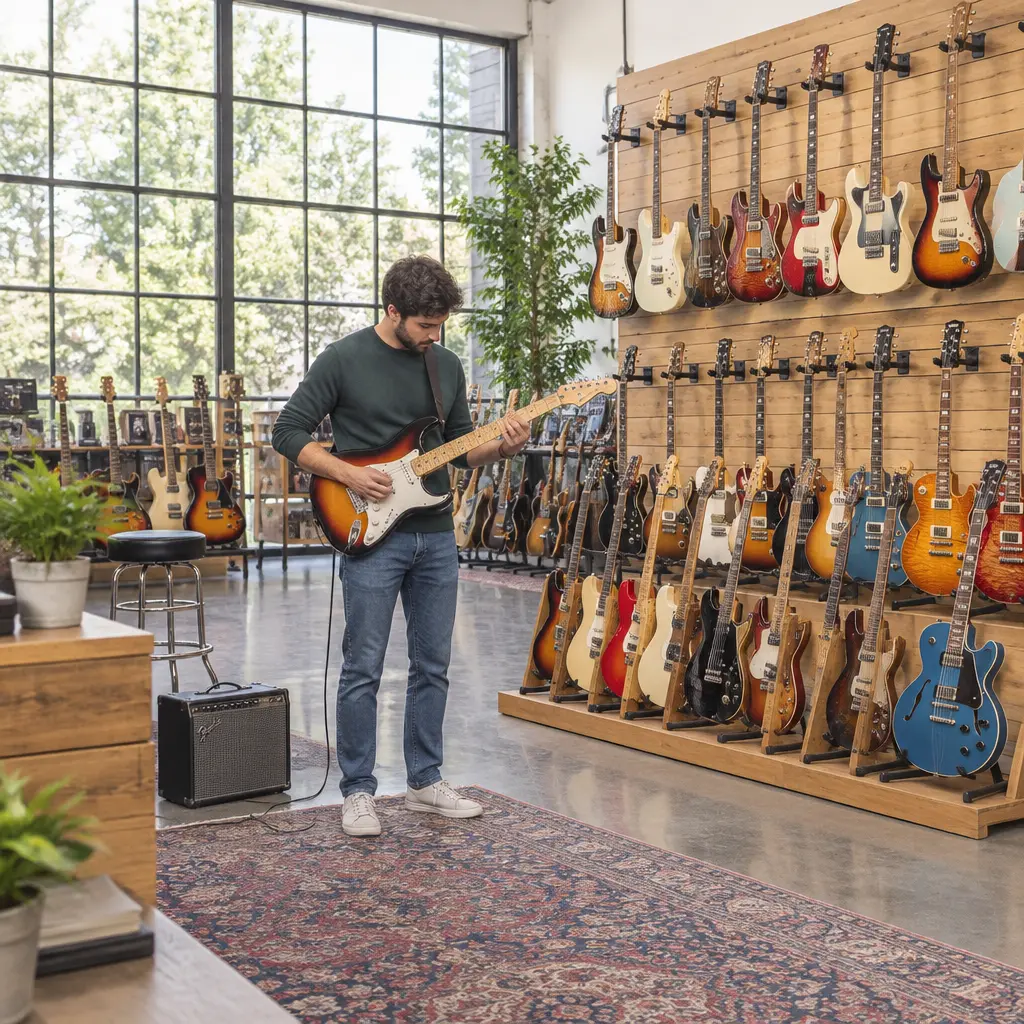
High-end import guitars can be worth their price when their construction, playability, sound, or quality control delivers benefits a player will actually use—but a higher price does not automatically mean a better instrument. “High-end import” generally describes guitars made outside a brand’s home country and sold near the premium end of that brand’s range; country of manufacture alone cannot establish quality. Comparing specific models, setup, materials, warranty, and resale value is more useful than comparing labels. These factors matter in a global guitar industry where manufacturing is distributed across countries and product tiers, and where players can often find similar features at sharply different prices.
What High-End Import Guitar Quality Means
A high-end import guitar is best understood as a model made in a country other than the brand’s principal or historically associated production country, positioned toward the upper end of its own lineup. “Import” is a relationship between the manufacturing location and the market where the guitar is sold, not a technical grade. The term can cover instruments made in Japan, South Korea, Indonesia, China, Mexico, or elsewhere, and each country contains factories operating at different price points and specifications.
The U.S. Federal Trade Commission’s country-of-origin guidance makes an important distinction: a “Made in USA” claim generally requires that a product be “all or virtually all” made in the United States. That labeling standard does not rate an instrument’s workmanship; it simply illustrates why origin and quality are separate questions. For guitar buyers, the relevant evidence is the individual instrument’s fit and finish, fretwork, hardware, electronics, consistency, and service support.
Build quality and consistency
Build quality is how accurately and reliably a guitar is assembled, including neck alignment, fret leveling, nut slots, bridge placement, finish work, and wiring. A premium import may provide careful detailing and dependable production without being made in the brand’s most expensive domestic facility. But quality control varies by factory, model, production run, and even individual instrument, so a reputation attached to a country or factory should be treated as a starting point rather than proof.
A useful comparison is to inspect several examples of the same model. Look for sharp fret ends, uneven frets, noisy controls, poor tuner operation, loose hardware, or finish defects. Ask whether the price includes a professional setup: a well-adjusted guitar can feel substantially better than a more expensive instrument that has not been checked carefully.
Materials and specifications
Specifications describe the parts and design choices used to build a guitar: body and neck construction, fingerboard, pickups, bridge, tuners, fret size, finish, and electronics. Higher-priced import models may add features such as stainless-steel frets, locking tuners, upgraded pickups, a carved top, or more elaborate finishing. Those features can be valuable, but only if they suit the player’s needs; a familiar neck profile or stable bridge may matter more than an expensive wood or cosmetic upgrade.
Wood names alone do not predict how an electric guitar will sound. In a 2012 paper in the journal Acoustics Australia, researchers explored the acoustic properties of electric-guitar bodies and emphasized that instrument response is influenced by interacting design and material factors. Pickups, strings, setup, amplification, and playing technique also shape the final sound. Buyers should therefore compare guitars through the same amplifier and signal settings rather than relying on a specification sheet or tonewood claims alone.
Why High-End Import Guitar Prices Differ
The retail price of a guitar reflects more than factory labor. It can include materials, design and development, quality checks, shipping, tariffs, distribution, dealer costs, warranty support, and brand positioning. The U.S. International Trade Commission’s Harmonized Tariff Schedule classifies musical instruments in Chapter 92, illustrating that import costs can depend on product category and applicable trade rules. Those costs may affect retail prices, but they do not tell a buyer whether one guitar plays or sounds better than another.
Brand comparisons also require care. Two guitars with similar listed components may differ in neck dimensions, fret finishing, electronics installation, factory inspection, included case, or after-sale support. Conversely, two models from different countries can share designs and parts. The strongest value comparison is therefore model against model, not country against country.
Manufacturing location and production tier
Manufacturing location identifies where an instrument is made; production tier describes its position in a company’s range. These are related but not interchangeable. A manufacturer may operate several facilities, outsource different models, or change production arrangements over time. A country label cannot reveal the amount of handwork, inspection time, or component quality assigned to a specific guitar.
For a real-world example, Fender’s Player II series is manufactured in Mexico, while its American Professional II series is made in the United States. Their prices and feature sets differ, but the comparison is not simply “import versus domestic”: each is a distinct product line with its own specifications and intended market. Buyers should check current manufacturer specifications and compare the instruments directly, since product details and availability can change.
Labor, distribution, and brand premium
Labor is one cost component, but no single labor-cost figure explains a guitar’s retail price. Skilled production, parts sourcing, factory investment, shipping, warehousing, dealer margins, marketing, and warranty obligations all contribute. Premium pricing may also reflect a brand’s reputation, design history, or perceived status. Those qualities may matter to a buyer, but they are not the same as measurable improvements in tone or reliability.
A practical way to evaluate the premium is to list the differences between two candidate guitars and assign value only to features that matter personally. If the more expensive model’s upgrades would otherwise require costly modifications, the price gap may be reasonable. If its main advantages are a logo, finish, or country association that the player does not value, the less expensive instrument may be the better purchase.
When a High-End Import Guitar Is Worth It
A high-end import is worth its price when it offers reliable construction and a playing experience that justifies the difference over more affordable alternatives. That judgment is personal, but it can be made systematically: compare the guitar’s feel, sound, tuning stability, features, support, and total ownership cost. A model that inspires regular playing may be a better value than a cheaper instrument that prompts immediate upgrades or remains unused.
Playability, sound, and useful upgrades
Playability is how comfortably and consistently an instrument responds to the player. Neck shape, fret condition, action, radius, nut work, and setup all contribute. Sound depends on the guitar’s complete signal chain, including pickups, controls, strings, amplifier, effects, and technique. A premium import is especially compelling when its stock configuration already fits the player’s style and avoids modifications that would add cost or reduce reliability.
Test the same musical passages on each candidate: open chords, bends, high-register notes, quiet playing, and hard picking. Listen for unwanted buzz, dead spots, tuning drift, and electrical noise. Compare clean and driven tones at matched volume, because louder instruments can seem more impressive even when their underlying sound is not preferable.
Reliability, warranty, and service
Reliability is the ability of a guitar to remain playable and function correctly with ordinary care. A warranty can reduce financial risk, but its length and coverage vary by brand, seller, and country. Before buying, confirm who handles warranty claims, whether labor and shipping are covered, and whether authorized repair is available locally. For an imported instrument, service access can be as important as the original purchase price.
A pre-purchase inspection should include the neck, frets, tuners, bridge, output jack, switches, and controls. For online purchases, review the seller’s return window, shipping protection, and return-shipping terms. These checks do not guarantee trouble-free ownership, but they make the decision more informed than relying on a product description alone.
Resale value and total cost of ownership
Total cost of ownership includes the purchase price plus setup, maintenance, repairs, upgrades, accessories, and eventual resale proceeds. Resale value depends on demand, condition, originality, brand recognition, and the used market; it is not guaranteed by a high initial price or domestic manufacture. Compare completed sales for the exact model and condition rather than asking prices, which show what sellers hope to receive, not what buyers paid.
A simple calculation can clarify the decision: purchase price, plus expected setup and upgrades, minus realistic resale value. If a high-end import arrives with the features and setup the player needs, it may cost less over time than a cheaper guitar requiring substantial work. If the player expects to sell soon, a popular, readily resold model may be more practical than a niche instrument, regardless of origin.
How to Compare High-End Import Guitars
A structured comparison reduces the influence of brand assumptions and showroom impressions. The following checklist works for both in-person and online purchases:
- Compare the exact model year and specifications, not just the brand or country of manufacture.
- Play multiple examples when possible, checking fretwork, neck comfort, tuning stability, and electronics.
- Test through the same amplifier and settings at similar volume.
- Include setup, case, shipping, taxes, and likely modifications in the total price.
- Read the warranty and return policy, and confirm access to repair support.
- Check recent completed used sales if resale value matters.
A comparison chart can make trade-offs visible: list each candidate’s price, construction, hardware, pickups, setup condition, warranty, and estimated resale value. Give each category a weight based on personal priorities. A gigging player may prioritize stability and serviceability, while a collector may place greater weight on rarity, finish, or brand history.
Conclusion: Are High-End Import Guitars Worth the Price?
High-end import guitars can be excellent value, but “import” is not a verdict on quality and “high-end” is not proof of superiority. Build consistency, useful specifications, playability, sound, warranty support, and total ownership cost are more meaningful measures. Manufacturing location can influence price and production arrangements, yet it cannot replace evaluating the individual instrument.
The best next step is to compare specific models, play or inspect individual examples, and calculate the full cost after setup and likely upgrades. Use manufacturer specifications, seller policies, and reliable used-market evidence to support the decision. Choose the guitar that meets your needs and makes you want to play; pay a premium only when its tangible benefits are worth it to you.
Sources: Federal Trade Commission, “Made in the USA,” https://www.ftc.gov/business-guidance/advertising-marketing/made-usa; International Trade Commission, Harmonized Tariff Schedule of the United States, Chapter 92, https://hts.usitc.gov/current; Fender, Player II Series, https://www.fender.com/en-US/electric-guitars/player-ii/; Fender, American Professional II Series, https://www.fender.com/en-US/electric-guitars/american-professional-ii/; Wegst, Ulrike G. K., “Acoustic Properties of Wood: A Review,” The Journal of the Acoustical Society of America, 2006, https://doi.org/10.1121/1.2184190.