
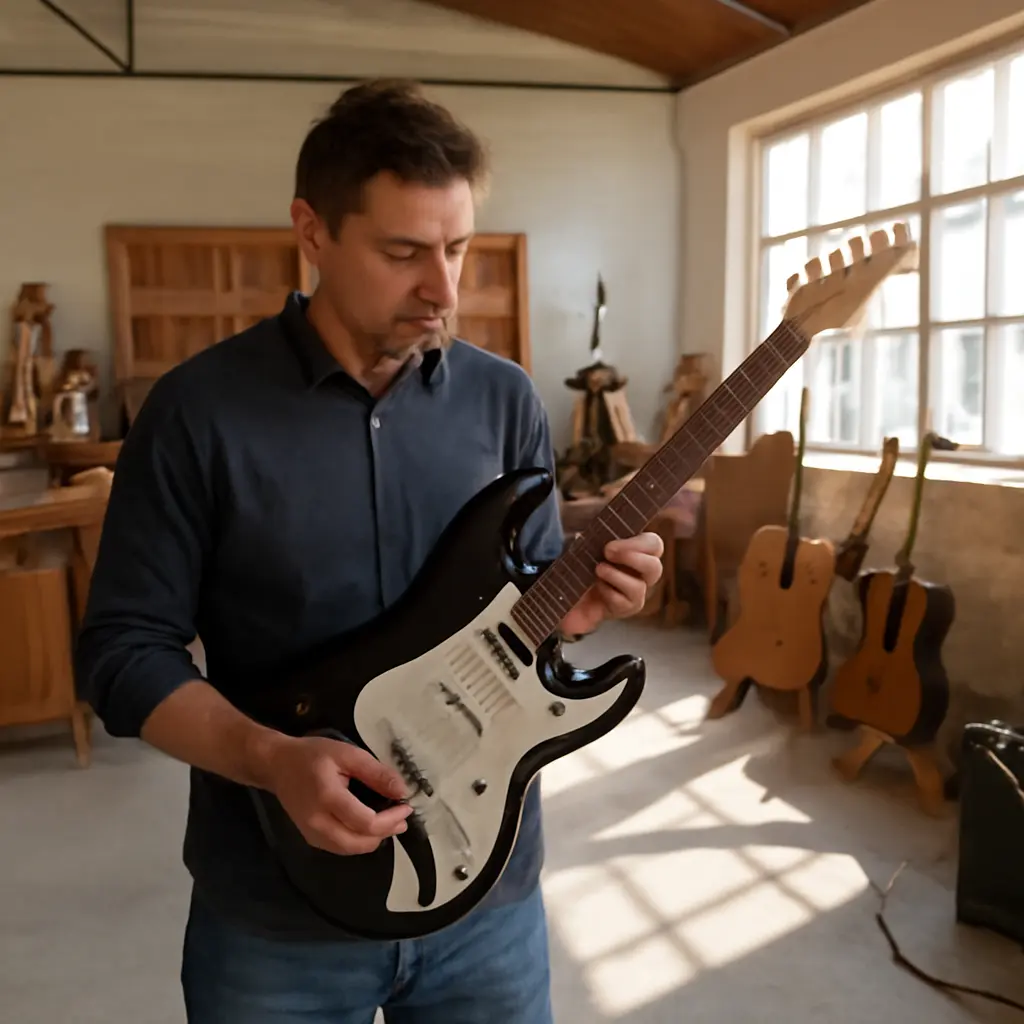
A signature guitar, bass, or drum kit is a model designed and marketed around a particular musician’s name, style, or preferences—but it does not necessarily reproduce the exact instrument that musician used on a recording or tour. Signature models translate selected features into a repeatable, commercially available product; the original instrument may have been customized, modified, vintage, or simply different. That distinction matters to musicians and buyers: Fender’s long-running artist collaborations and Gibson’s signature ranges show how artist identity can shape instruments, while manufacturer specifications and musicians’ own accounts reveal that a signature model is better understood as an interpretation than a literal replica. This article explains how signature models are defined, why they diverge from the instruments artists actually played, how to evaluate their specifications, and what notable examples can teach buyers.
Manufacturers define signature models as artist-linked designs
A signature model is a commercially produced instrument associated with a named artist, usually through a collaboration, endorsement, or licensed design. The artist may contribute preferences or approve features, while the manufacturer adapts those ideas for production, price, reliability, and a broader market. The term does not, by itself, promise that the model is identical to the artist’s personal instrument.
This distinction is visible in manufacturers’ own product language. Fender describes artist models through selected specifications—such as pickups, neck profiles, finishes, and hardware—rather than claiming that every instrument is a one-to-one copy of a performer’s working guitar. Gibson likewise presents signature instruments as artist-associated models with defined production specifications. Those specifications are the verifiable description of the product; stories about the artist’s original instrument provide context, but are not a substitute for them.
Artist models and signature models
An artist model is an instrument designed or specified in collaboration with a musician, or at least closely associated with that musician. “Signature model” is often used in the same way, particularly when the artist’s name appears in the model’s official title. These labels describe a relationship and a marketing category; they do not establish how closely a production instrument matches a stage or studio original.
The artist’s contribution can range from choosing a familiar neck shape or pickup configuration to approving a distinctive body design. Production models may also differ by year, factory, or price tier. A signature name therefore signals a useful starting point for research, not proof that every unit contains the same components as the artist’s instrument.
Custom-shop replicas and production signatures
A custom-shop replica aims to reproduce a particular instrument or historical example in unusually close detail. A production signature model, by contrast, is generally made to a repeatable specification and offered to customers at a defined price. Even when a manufacturer sells a high-end artist model, its official specifications—not the word “signature”—determine whether it is intended as a faithful replica.
The categories can overlap: a company may offer both an accessible production instrument and a limited, more exacting artist edition. Buyers should compare the model’s stated materials, electronics, construction, and documented provenance instead of assuming that a famous name means a replica.
Production choices separate signature models from artists’ originals
The gap between an artist’s instrument and a retail signature model often comes from practical compromises. A musician’s original may have accumulated decades of wear, repairs, replacement parts, and personal modifications. A manufacturer must create instruments consistently, source components, meet safety and quality requirements, and set a price that customers can reach. These goals can produce a model that captures the player’s recognizable preferences without duplicating every detail of the instrument heard on a recording.
Personal modifications are hard to reproduce
Artists commonly alter instruments to suit their technique: a guitar may receive replacement pickups, a rewired circuit, a reshaped neck, a different bridge, or years of repairs. Those changes may be undocumented or may have occurred after the recording associated with the instrument. A factory model can reproduce a known modification, but it cannot automatically reproduce the full history, condition, or setup of a particular original.
A useful example is the relationship between a famous player’s heavily customized guitar and a commercial model based on its visible features. The retail version may adopt the body style, finish, or pickup arrangement while using current components and standardized construction. The result can be a practical instrument inspired by the original, not a time capsule of its exact recording-era configuration.
Manufacturing consistency and price shape specifications
A musician’s personal instrument may contain scarce vintage parts or one-off work that would be costly or difficult to reproduce at scale. Manufacturers may choose readily available components, modern production methods, or simplified finishing to make a model consistent and commercially viable. Different versions of an artist model can consequently occupy distinct price levels and include different specifications.
This is why a buyer should check the exact model and production year. A name can remain familiar while details change, including pickup design, country of manufacture, neck dimensions, hardware, and included accessories. Manufacturer specification sheets and archived catalogs are more reliable for those details than broad claims that a model is “the same guitar” an artist used.
A recording’s sound is not only the instrument
An instrument contributes to a recorded tone, but the final sound also reflects playing technique, amplification, effects, microphones, room acoustics, recording equipment, and production choices. The National Recording Preservation Board’s work on preserving recorded sound underscores that recordings are products of complex technical and artistic processes, not isolated instruments. Recreating a model’s listed specifications therefore cannot guarantee an identical recorded sound.
For example, a signature guitar may use pickups associated with an artist, yet sound different through another amplifier or with a different picking attack. Conversely, a musician may approximate a familiar tone using another instrument and signal chain. The practical lesson is to evaluate an instrument for its own playability and sound rather than treating a signature label as a promise of a specific record’s tone.
Artist histories show why signature models are interpretations
Well-known instrument histories make the distinction especially clear: the public image of an artist’s instrument is often simpler than its real-world history. Artists switch instruments, alter them, and use different setups across sessions and performances. A signature release can honor a recognizable design while representing only one chapter—or one interpretation—of that history.
Eric Clapton and the Fender Stratocaster
Fender’s Eric Clapton Stratocaster is a production signature model associated with the guitarist’s preferences. Fender’s published specifications describe a defined commercial instrument, including features such as its neck profile, pickups, and electronics. Clapton’s personal instruments and historical setups, however, have changed over time; the model should be read as a factory-built expression of selected preferences, not as proof that every guitar he played had those same specifications.
The example illustrates how signature instruments can be genuinely artist-informed without being exact copies. A prospective buyer can compare the official model details with historical accounts of the artist’s instruments, then decide whether the production design suits their own needs.
Eddie Van Halen and the Frankenstrat
Eddie Van Halen’s Frankenstrat is a celebrated example of a guitar assembled and modified to meet an individual player’s aims. Its history is associated with experimentation and changes over time, rather than a fixed factory recipe. Commercial recreations can reproduce selected visual and construction details, but a production instrument remains a manufactured interpretation of a particular historical object.
This case also shows why visual resemblance can be misleading. A guitar with a familiar striped finish may evoke the original but differ in neck, pickups, wiring, hardware, setup, or period-specific details. Buyers seeking a replica should look for documentation that identifies exactly which version or state of the original the instrument represents.
Signature instruments across guitars, basses, and drums
The same principle applies beyond electric guitars. Signature basses may reflect a player’s preferred scale, pickup arrangement, neck feel, or electronics, while signature drum products may adopt a preferred shell, finish, or hardware configuration. In each case, the commercial product represents selected design choices; it does not establish that the artist used that exact retail specification on every recording or performance.
The relevant evidence varies by instrument. Guitar and bass buyers can compare component and wiring specifications; drum buyers can examine shell construction, dimensions, heads, and hardware. Artist interviews, manufacturer documentation, and well-sourced instrument histories can help distinguish documented facts from promotional shorthand.
Buyers can verify what a signature model actually offers
A careful purchase starts by separating three questions: what the artist actually used, what the manufacturer built, and what the buyer needs. Answering them avoids paying for a name when the instrument’s practical features do not fit. It also helps identify when a signature model is a worthwhile design collaboration rather than a claimed replica.
Check primary specifications and production year
Use the manufacturer’s product page, owner’s manual, catalog, or archived specification sheet to verify the model’s construction and components. Check the instrument’s production year and version, since specifications can change. If a seller claims that a feature matches an artist’s original, look for a reliable source that documents that specific detail.
Separate documented history from promotional language
Artist interviews, museum or manufacturer histories, and reputable instrument references can establish what is known about a personal instrument. Marketing descriptions may accurately describe a collaboration but use evocative language that does not amount to a technical claim. Treat words such as “inspired by,” “based on,” and “replica” according to their context, and seek specific evidence when exact historical accuracy matters.
Test the instrument for the player, not the celebrity
Neck feel, balance, weight, fretwork, tuning stability, and sound through the player’s own setup have more direct consequences than an artist association. When possible, compare the signature instrument with a standard model at a similar price. The signature version is most valuable when its particular features genuinely suit the player—not merely because it carries a famous name.
A comparison chart can make the decision clearer: list the artist’s documented instrument details, the manufacturer’s published specifications, and the features that matter to the buyer. Where evidence is uncertain, mark it as unknown rather than treating an assumption as fact.
Conclusion: Signature models preserve ideas, not always exact instruments
Signature models are artist-linked designs, but their names do not guarantee exact replicas. Production requirements, personal modifications, changing specifications, and the many contributors to recorded sound all help explain why a retail model may differ from the instrument an artist actually played. Historical examples—from Eric Clapton’s Fender collaboration to recreations of Eddie Van Halen’s Frankenstrat—show that a signature model is best understood through its documented specifications and context.
Before buying, compare manufacturer documentation with credible histories, verify the production year, and try the instrument on its own merits. For further research, consult official product specifications, artist interviews, and reputable instrument histories. That approach helps musicians appreciate signature models for what they offer: a usable design shaped by an artist’s identity, rather than an automatic replica of a recording’s sound or a musician’s entire instrument history.
Sources: Fender, Eric Clapton Stratocaster product information, https://www.fender.com/en-US/electric-guitars/stratocaster/eric-clapton-stratocaster/; Gibson, Artist Collection, https://www.gibson.com/en-US/Collection/artist; National Recording Preservation Board, The Library of Congress National Recording Preservation Plan, https://www.loc.gov/programs/national-recording-preservation-board/about-this-program/; Fender, Eddie Van Halen and the Frankenstrat, https://www.fender.com/articles/gear/eddie-van-halen-and-the-frankenstrat


