
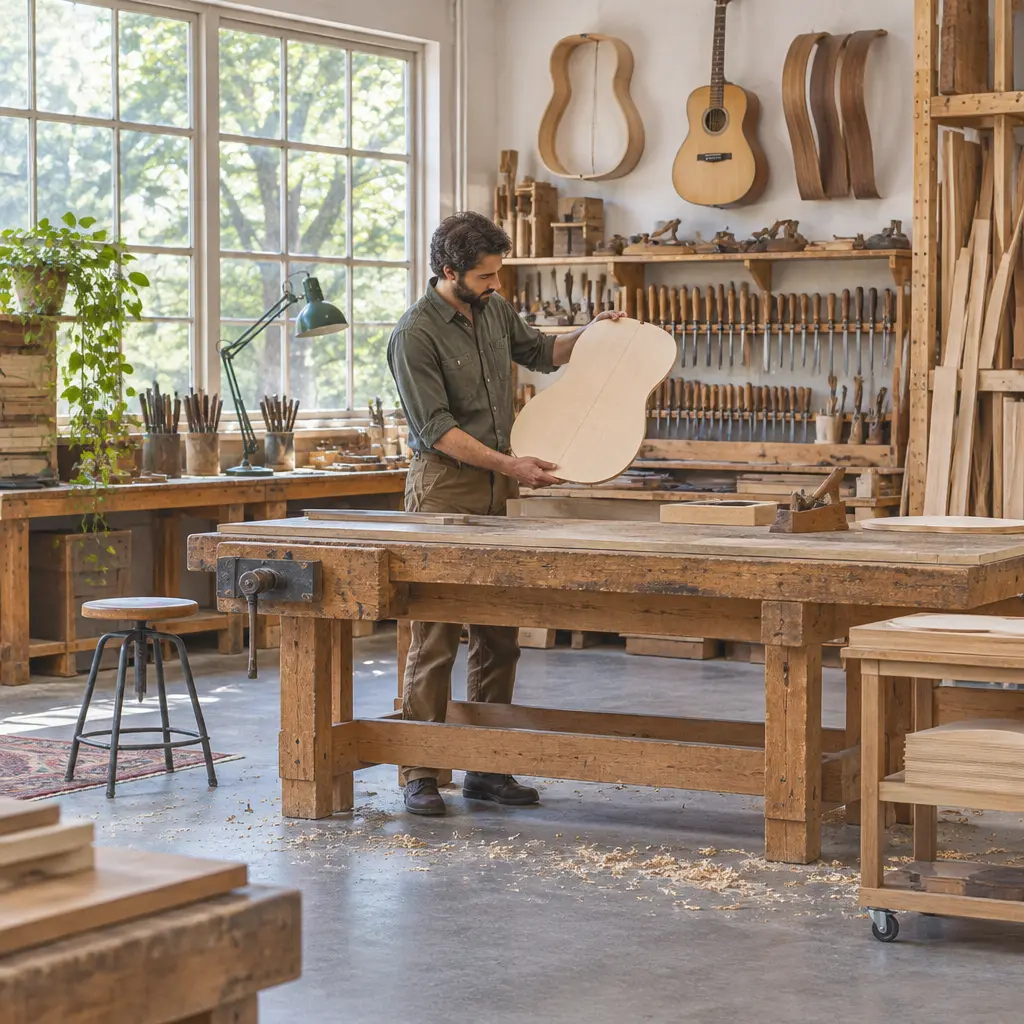
A guitar’s top, also called its soundboard, is the wood panel that most directly shapes how an acoustic guitar responds and projects sound. Choosing one means balancing tone, playing style, construction, appearance, budget, and sustainability—not simply selecting the “best” species. Sitka spruce is a versatile, widely used option; cedar often responds readily to a light touch; and mahogany and other hardwoods can provide a different balance of attack and tonal character. The right choice depends on the guitar’s design and the player, while the wood’s grade, thickness, bracing, and build quality also matter.
The Guitar Top’s Sound and Structural Role
The top is the soundboard: the broad plate attached to the body that vibrates when strings transfer energy through the bridge. The National Guitar Workshop’s lutherie materials describe the soundboard as a key component of an acoustic instrument’s sound-producing system. Its response is affected not only by species, but also by stiffness, density, grain orientation, thickness, bracing, body shape, and construction.
A top does not create a fixed tone in isolation. The back and sides, neck, strings, setup, and player’s technique contribute to the result, and differences between two individual pieces of the same species can be substantial. Accordingly, species descriptions are useful tendencies rather than guarantees.
How the Soundboard Produces Sound
When a string vibrates, the bridge transmits energy to the soundboard. The top flexes, moving air in the body and helping radiate sound outward. Its ability to respond depends on the relationship between mass and stiffness: a well-designed top needs to move efficiently while remaining strong enough to withstand string tension. This is why a builder’s graduation and bracing choices can matter as much as the wood name on a specification sheet.
What Players Mean by Tone
Descriptions such as “warm,” “bright,” “quick,” or “punchy” are practical listening terms, not standardized measurements. Players may use them to describe attack, sustain, perceived emphasis across frequencies, or how the instrument responds to a particular touch. A useful comparison therefore involves playing guitars with similar body shapes and setups, ideally with the same strings and musical passage.
Top-Wood Choices for a Custom Guitar
Common top woods fall into several practical categories: spruce varieties, cedar, and hardwood soundboards such as mahogany. Luthiers and manufacturers often select a species for its working properties and customary tonal character, but the finished instrument reflects the entire design. The following comparisons are starting points for discussion with a builder, not promises about how every guitar will sound.
Sitka Spruce: A Versatile Starting Point
Sitka spruce is a widely used soundboard wood associated with a broad dynamic range and adaptability to different playing approaches. Its popularity makes it a sensible candidate for a first custom steel-string guitar, particularly when the player wants one instrument for strumming, flatpicking, and fingerstyle. A specific Sitka top can still vary in weight, stiffness, grain, and appearance, so the builder’s assessment of the actual set is more informative than the species label alone.
Cedar: Responsive Under a Lighter Touch
Western red cedar is commonly chosen for instruments intended to respond readily to a lighter attack. Players often associate it with a warm, immediate sound, which can suit fingerstyle and nuanced dynamics. That reputation is not a rule: top thickness, bracing, body dimensions, and individual wood properties can change the outcome. A player who strums very forcefully should ask the builder whether the proposed design is appropriate for that attack.
Mahogany and Other Hardwood Tops
Mahogany soundboards are used for a more focused voice that many players describe as direct, woody, or dry. They can be worth considering for blues, roots music, and players who want strong note separation rather than a lush, overtone-rich presentation. Other hardwoods may also be used in custom designs, but their behavior depends on the species and the builder’s approach. Because hardwood tops are less commonly encountered than spruce or cedar in many steel-string ranges, it is especially helpful to audition a comparable instrument.
European and Adirondack Spruce
European spruce and Adirondack spruce are alternatives often selected for particular combinations of response, headroom, and tonal color. Adirondack spruce is frequently associated with strong projection and the ability to accommodate a forceful attack, while European spruce is valued by some builders and players for its balance and responsiveness. These are broad market descriptions, not controlled guarantees; availability, grading practices, and the individual set all influence cost and performance.
Matching a Top to Playing Style and Guitar Design
Once the candidate woods are clear, the next step is to match the top to how the guitar will be played. A custom builder can tune the design through top thickness, bracing pattern, body size, and other choices. The goal is a coherent instrument, not a particular species in isolation.
Fingerstyle and Light Attack
For fingerstyle playing or a light touch, consider a top and bracing design that responds clearly without requiring high string energy. Cedar is a common candidate, while a carefully voiced spruce top may also work well. Ask the builder to describe the instrument’s response at low volume and whether it remains balanced when several notes are played simultaneously.
Strumming, Flatpicking, and Strong Attack
Players who strum hard or play with a flatpick often need a guitar that retains definition as volume increases. Sitka and Adirondack spruce are frequently considered for this purpose, but the guitar’s bracing and body design are essential parts of the decision. A useful test is to play softly, then increase attack gradually and listen for whether the sound stays clear or becomes compressed and less distinct.
Body Size, Bracing, and Scale of the Instrument
A top works within the dimensions of the whole instrument. A small-bodied guitar and a large-bodied guitar can differ in air volume, feel, and projection even when they use the same species. Bracing distributes structural support and influences how freely the soundboard moves. Ask the builder how the proposed top wood interacts with the chosen body size and bracing pattern rather than assuming a species will sound the same across every model.
Evaluating Quality, Cost, and Sustainability
Species is only one purchasing criterion. The quality and preparation of the actual top, the builder’s workmanship, and the instrument’s long-term care all affect value. Environmental sourcing also deserves attention, especially for tropical hardwoods and other woods whose trade may be regulated.
Inspecting the Wood and the Build
A builder may evaluate a soundboard for stiffness, weight, grain runout, defects, and suitability for a particular design. Straight-looking grain can be visually appealing, but appearance alone does not establish acoustic quality. Ask whether the top is solid or laminated, how it is braced, and what the builder has done to voice it. Also inspect the finished guitar for stable setup, clean construction, and a response that suits your playing.
Budget and Premium Options
Uncommon species, visually distinctive sets, and highly selective grades can raise the price, but a premium wood designation does not automatically produce a better instrument for a particular player. It is often more valuable to prioritize a well-executed design, comfortable setup, and suitable response. Request a written quote that separates any upcharge for a selected top from the base cost of the custom build.
Responsible Sourcing and Trade Rules
The Convention on International Trade in Endangered Species of Wild Fauna and Flora (CITES) regulates international trade in listed species through permits and documentation requirements; rules can change and may depend on the species, product, and transaction. The U.S. Fish and Wildlife Service provides guidance on wildlife-trade requirements. Before ordering a guitar that uses a regulated wood, ask the maker to identify the species and document its origin, and check current rules for the countries involved. Sustainable sourcing and legal compliance are related but distinct questions.
A Practical Method for Choosing
A structured comparison helps turn broad wood descriptions into a decision grounded in listening and use. Bring the builder specific musical examples and discuss how the instrument should perform at both quiet and high volume.
- Define your main playing style, typical attack, and musical setting.
- Choose the body shape and scale length before treating the top wood as a standalone choice.
- Compare instruments with similar designs, setups, and strings where possible.
- Ask the builder how the actual top set’s stiffness and weight influence thickness and bracing.
- Confirm the price, wood species, sourcing documentation, care requirements, and any trade restrictions.
- Select the guitar that feels and sounds right to you, rather than relying on a species reputation alone.
A comparison chart can help organize auditions: list candidate woods in rows and rate each guitar for response to a light touch, clarity under hard strumming, note separation, comfort, price, and sourcing confidence. Treat these ratings as personal observations, not laboratory measurements.
Conclusion: Choose the Soundboard as Part of the Whole Guitar
The guitar top is a central sound-producing component, but its species alone cannot predict the finished instrument. Sitka spruce offers a versatile starting point, cedar is often considered for a responsive light touch, and mahogany or other alternatives may suit players seeking a more focused character. Body size, bracing, the individual wood set, workmanship, and playing technique complete the picture.
Before commissioning a custom guitar, audition comparable instruments, explain your playing style to the builder, and ask about the specific top, design, cost, and sourcing. Further reading from the National Guitar Workshop, CITES, and the U.S. Fish and Wildlife Service can help you understand soundboard construction and responsible wood trade.
Sources: National Guitar Workshop, Guitar Construction and Lutherie educational materials, https://www.guitar.com/; Convention on International Trade in Endangered Species of Wild Fauna and Flora (CITES), Appendices, https://cites.org/eng/app/appendices.php; U.S. Fish and Wildlife Service, International Affairs: CITES, https://www.fws.gov/program/international-affairs/cites


