
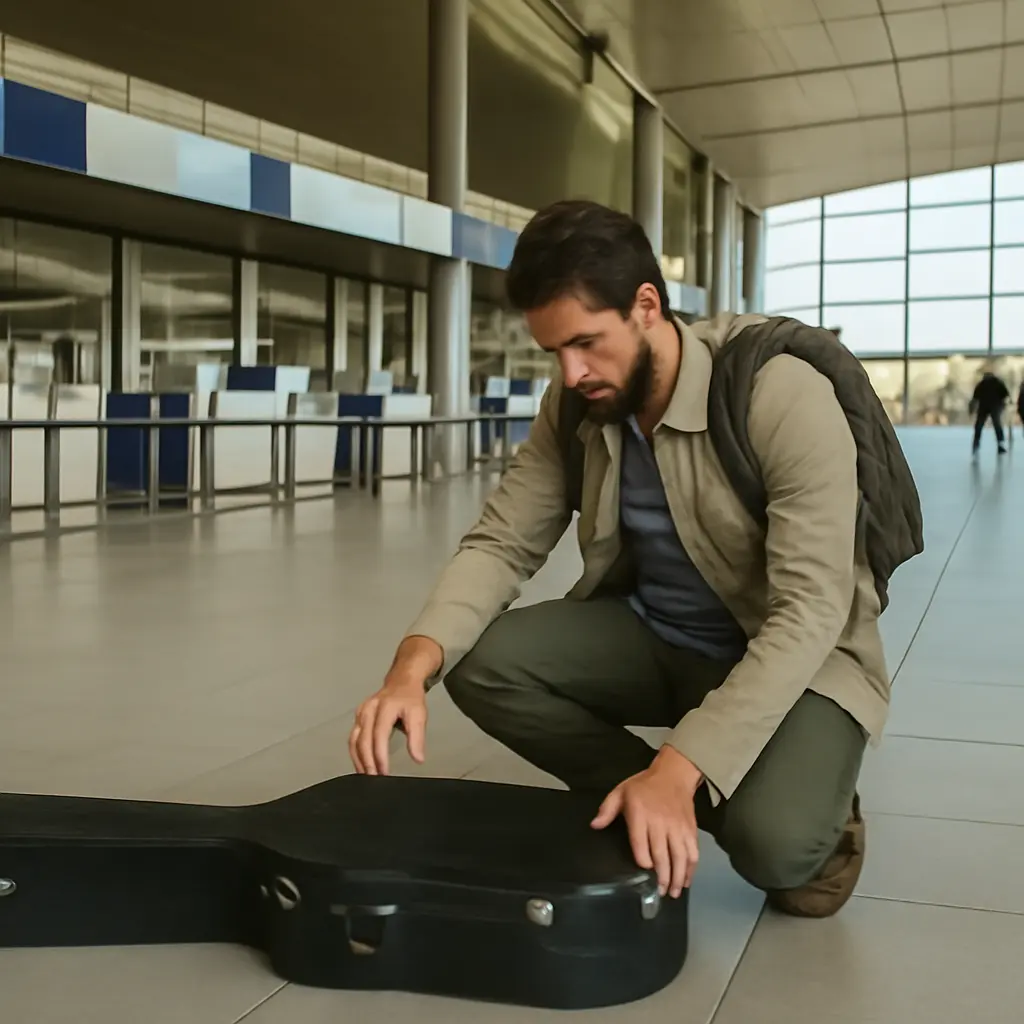
Airline guitar policies are the rules and practices airlines use to decide whether a guitar may travel in the cabin, must be checked, or can be accommodated through an approved seat purchase. Over the next few years, the most likely direction is not a universal “guitars welcome” rule, but clearer advance information, more emphasis on aircraft and cabin-space limits, and continued variation by airline and route. In the United States, federal law generally requires covered airlines to allow a guitar in the cabin when it fits safely in an approved stowage area at boarding; it does not guarantee a place for every instrument. That distinction matters to musicians: the Federal Aviation Administration reported more than 850 million U.S. passenger enplanements in 2023, while a guitar’s size, fragile construction, and replacement cost make last-minute uncertainty unusually consequential.
How airline guitar policies define cabin carriage
A guitar policy is an airline’s practical interpretation of baggage rules, cabin-safety requirements, and any applicable law. The U.S. Department of Transportation explains that the FAA Modernization and Reform Act of 2012 requires U.S. airlines to permit a small musical instrument as carry-on baggage when it can be safely stowed in an approved location and space is available at boarding. If it cannot be safely accommodated in the cabin, the airline may require it to be checked. The law also allows an airline to sell a separate seat for an instrument that fits safely in that seat or an adjacent area, subject to its rules.
This is a conditional right, not a guarantee that every guitar case will fit in an overhead bin. Airlines still apply cabin-bag limits, aircraft-specific stowage constraints, boarding procedures, and safety rules. Policies also differ outside the United States, so musicians should treat each carrier’s published terms—not a general assumption about airline practice—as the operative guide.
Carry-on guitars: the space-and-safety test
A carry-on guitar is an instrument brought into the passenger cabin, usually in a hard or padded case. Under U.S. federal law, the key questions are whether the instrument can be safely stowed in an approved compartment and whether space remains when the passenger boards. A guitar’s case may exceed an airline’s ordinary carry-on dimensions, but that does not by itself settle the question: the federal musical-instrument provision addresses safe stowage, while the airline’s staff must still manage limited cabin space and safety.
For travelers, the distinction between “allowed” and “guaranteed space” is essential. A full flight, a smaller aircraft, or an unusually large case can change the outcome. Policies may also distinguish between a guitar carried as the passenger’s main cabin item and one carried in addition to a standard bag. Check the carrier’s current instrument policy and ask about the specific aircraft and itinerary before travel.
Checked instruments: acceptance is not a promise of damage-free travel
A checked guitar travels in the aircraft hold and is subject to the airline’s baggage-acceptance rules, fees, handling procedures, and liability limits. The U.S. Department of Transportation’s musical-instrument guidance says airlines may require an instrument to be checked if it cannot be safely accommodated in the cabin. A hard case, appropriate packing, and removal or protection of loose components can reduce exposure, but no case makes rough handling impossible.
The risk is not merely theoretical: the U.S. Bureau of Transportation Statistics tracks mishandled baggage across U.S. carriers, although its aggregate figures do not isolate guitars or quantify instrument damage. That limitation is a reason to avoid treating general baggage statistics as a guitar-specific forecast. Musicians should review the airline’s liability terms, document the instrument’s condition, and consider specialist insurance when the instrument’s value or professional importance warrants it.
Buying a seat for a guitar: a niche but established option
An extra-seat arrangement means purchasing a passenger seat for an instrument that can be safely secured there under the carrier’s procedures. U.S. federal law recognizes this possibility, but does not make it a universal service with identical booking steps across airlines. The instrument must meet the airline’s safety and restraint requirements, and the passenger should confirm how the extra seat is ticketed, where the case may be placed, and whether the route or aircraft permits the arrangement.
This option is most relevant for valuable, unusual, or especially fragile instruments that cannot reliably travel in a bin. It is less convenient and can be costly, but it offers a planned alternative to hoping that cabin space will remain available at boarding. As airlines refine booking and service systems, clearer online instructions for extra-seat instrument travel are a plausible improvement; broad adoption, however, is not assured.
Why airline guitar policies may become clearer, not uniform
The strongest near-term pressure is likely to be for consistency in information rather than identical treatment on every flight. Airlines operate different aircraft, cabin layouts, and baggage programs, while guitar cases vary substantially in length and shape. A policy that works on a larger aircraft may not translate to a regional jet. The Federal Aviation Administration’s passenger-volume figures—more than 850 million U.S. enplanements in 2023—also underline the scale of the system in which cabin space must be allocated among passengers, bags, and safety equipment.
Digital policy and aircraft-specific guidance
Digital guidance means presenting instrument rules in booking tools, baggage pages, and trip notifications in ways that help passengers act before arriving at the airport. Over the next few years, airlines may provide more searchable instrument pages, clearer case-size advice, or prompts to contact the carrier when booking an extra seat. These are reasonable service improvements, not guaranteed industry-wide changes.
Useful guidance would identify the relevant aircraft or route, explain whether a guitar counts toward the cabin-bag allowance, and describe what happens if overhead space is unavailable. Travelers can encourage this clarity by checking the policy for every operating carrier on a codeshare itinerary and saving written confirmation where possible. A booking confirmation alone may not resolve a gate-side stowage decision, but specific documentation can help expose discrepancies between published rules and frontline practice.
Cabin capacity and aircraft variation
Cabin capacity is the practical constraint most likely to preserve differences in guitar treatment. Airlines must keep aisles and exits clear and secure baggage for takeoff and landing; a guitar cannot be placed wherever it is convenient. Smaller aircraft may have less suitable bin space, and a full flight can exhaust available stowage before a guitar-carrying passenger boards.
This means future policy improvements are likely to focus on setting expectations: advising passengers to board early when permitted, specifying acceptable stowage locations, and explaining fallback options. Early boarding may improve the chance of finding space, but it cannot override safety rules or create a legal guarantee of a particular bin. For musicians whose schedule depends on the instrument arriving intact, a backup plan remains important.
Consumer rights, enforcement, and uneven international rules
Consumer rights in this area combine legal protections with the practical limits of airline operations. In the United States, the Department of Transportation’s guidance describes the federal musical-instrument rule, while airlines retain responsibility for safe stowage decisions. Outside the United States, rules and enforcement may differ by country, airline, and route. A musician flying internationally should not assume that the U.S. provision applies to the entire itinerary.
A likely source of friction is the gap between a policy written in general terms and a decision made by airport staff under time pressure. Clearer definitions, staff training, and accessible complaint processes could reduce avoidable disputes. Travelers who believe a U.S. carrier did not follow applicable requirements can consult the Department of Transportation’s aviation consumer resources and retain receipts, photographs, and written communications relevant to the case.
What musicians can do now—and what to watch next
The most reliable approach is to plan for the policy that applies to the specific carrier, aircraft, and itinerary rather than rely on anecdotes from another flight. A guitar’s dimensions, case type, value, and the consequences of damage should guide the choice between cabin carriage, checking, and an extra seat.
- Measure the complete case, including handles and protrusions, and compare it with the airline’s current baggage and instrument guidance.
- Confirm the operating carrier and aircraft for every leg, especially on codeshare or connecting trips.
- Contact the airline in advance about an oversized case or extra-seat arrangement, and keep the response accessible while traveling.
- Use a protective case and suitable packing if checking is unavoidable; photograph the instrument and case before handing them over.
- Review baggage liability and insurance terms, particularly for high-value or working instruments.
A useful future measure would be publication of airline-by-airline data on instrument acceptance, forced gate-checking, and damage claims. Publicly available U.S. mishandled-baggage data are not guitar-specific, so they cannot show whether guitar outcomes are improving. Until comparable data exist, published policy quality and musicians’ documented experiences will remain important signals of whether airlines are making instrument travel more predictable.
Conclusion: expect clearer guidance, but keep a backup plan
Airline guitar policies are likely to evolve through better communication and more specific trip planning, not through a single global rule that guarantees every guitar a cabin space. U.S. law provides a meaningful conditional right to carry a qualifying instrument when it can be safely stowed and space is available, while checked baggage and extra-seat travel remain alternatives with their own limits. Aircraft capacity, international differences, and frontline safety decisions will continue to shape outcomes.
For musicians, the practical next step is to check the current policy for each operating carrier, confirm unusual arrangements before departure, and prepare for a change in stowage at the airport. For policymakers and airlines, clearer aircraft-specific guidance and better instrument-related data would make the rules easier to understand and evaluate.
Sources: U.S. Department of Transportation, Traveling with Musical Instruments, https://www.transportation.gov/airconsumer/air-travel-musical-instruments; U.S. Congress, FAA Modernization and Reform Act of 2012, Section 403, https://www.congress.gov/112/plaws/publ95/PLAW-112publ95.pdf; Federal Aviation Administration, Passenger Boarding and Enplanement Data, https://www.faa.gov/airports/planning_capacity/passenger_allcargo_stats/passenger; U.S. Bureau of Transportation Statistics, Airline Baggage Data, https://www.transtats.bts.gov/.


